Alex Säfström has published the whitepaper for the Kaspa Dollar, and readers spent the next day testing it in the replies. Can miners fake the price? What happens in a flash crash? Who pays when a vault goes under? Where do the first KaspaDollars come from? Between the paper and the answers from Säfström, the KaspaDollar account and Michael Sutton, most of those questions now have answers.
The short version is this. A KaspaDollar should keep at least a dollar of KAS behind it through a sudden KAS crash of up to 50%, and through a slower crash of any size, as long as people keep liquidating weak vaults. Faking the price would take close to half of all Kaspa mining power, and the system won't switch on until nearly every miner votes. The paper still awaits peer review, and its numbers can change.
The paper also fills gaps in the earlier design and changes how fees work. We covered that design in The buck stops here.
Can miners fake the price?
This was the biggest gap in the earlier design. The price feed depended on mining pools installing a voting plugin, but nobody had said how many were needed. A price window counts if at least half of its blocks carry a vote, so if only half the miners voted, a cheater with a quarter of the mining power could control the price.
Now there is a rule. Before launch, the system accepts price updates and nothing else. Nobody can open a vault or mint a single KaspaDollar. It switches on only after 30 days in a row in which at least 90% of blocks carry a vote, with no more than 30 minutes between price updates. One weak window or one long gap and the count starts again from zero. Once it switches on, it stays on.
With 90% of blocks voting, a cheater needs 45% of all mining power to control the price. Stopping the price feed by holding votes back takes more than 40%. If every block votes, both attacks need half, the same bar as a 51% attack on Kaspa itself. The 90% rule only applies before launch, though. After that, a window still counts with half of its blocks voting, so if miners later drifted away from voting, the bar for a cheater would drop with them.
When the paper was written, the biggest Kaspa pool had 32.7% of the mining power, so no single pool could do either attack. The two biggest pools together had 57.1%, enough for both, though together they could already attack Kaspa itself. A pool is many separate miners pointing their machines at one operator, and nobody knows how many of them would stay with a pool that cheated in public.
The design also assumes that most of the voting miners read prices from independent exchanges. If they all copied one source, that source would set the price. Kir P. asked whether miners would get a ready setup that pulls prices from several exchanges. The KaspaDollar account said miners will get ready-made software that can connect to any price source.
Peekaboo asked whether, once all KAS has been mined, miners might as well exploit Kaspa. Säfström answered with a question.
How the vote is counted
Each miner writes a KAS price into every block it mines. The vote takes 13 bytes in the coinbase payload, the small field of up to 204 bytes where a miner puts its payout details. The system takes a window of 6,000 blocks, about the last ten minutes, and uses the middle vote. As long as cheaters cast fewer than half of the votes, the middle vote lands somewhere between the lowest and the highest honest price.
Checking 6,000 votes inside a Kaspa script would be far too heavy. Instead, anyone with a strong enough computer can do the counting and send the result with a zero-knowledge proof, a short piece of math that shows the counting was done right. The vault scripts check the proof and compare it with a running fingerprint of the chain that Kaspa itself keeps, added by the KIP-21 proposal. A proof built on made-up blocks, or one that drops or adds a vote, doesn't match and fails. The window also picks the blocks with the most work behind them, so a miner gains nothing by hiding blocks and releasing them later.
Two prices instead of one
The vaults don't use one KAS price. They use two, both taken from the same middle vote. One is for borrowing and taking KAS out. The other is for liquidations and the $1 swap. Each one moves fast when that's safe and slowly when a sudden move could be abused.
Say KAS is at 3 cents and the market jumps to 4. The liquidation price follows as soon as the miners' vote shows it, so nobody can liquidate your vault at the old, lower price. The borrowing price climbs by at most 10% an hour, so it takes about three hours before you can borrow against the new price in full.
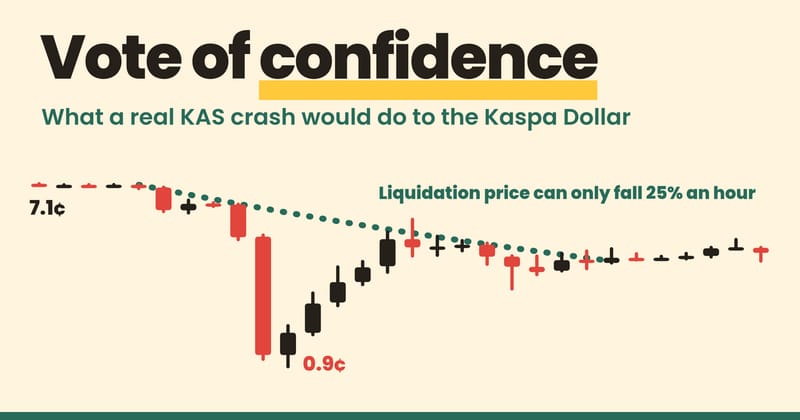
Now say KAS falls from 3 cents to 2. The borrowing price drops at once, so nobody can borrow against the old, higher price. The liquidation price falls by at most 25% an hour, so it takes almost an hour and a half to reach 2 cents.
This is what slows a cheater down. Even with control of the vote, doubling the borrowing price takes more than seven hours. Halving the liquidation price takes 2.4 hours, and pushing it down to a tenth takes eight.
There is a second brake on top. The number of KaspaDollars in circulation can grow by at most 50,000 a day across the whole system. A fake high price can't pump out more than that, but the cap also limits honest growth. Reaching a million KaspaDollars would take at least 20 days.
What a flash crash does
To borrow, your KAS must be worth at least 2.5 times the loan. Lock $250 of KAS and you can borrow 100 KaspaDollars. Once the KAS is worth less than twice the loan, anyone holding KaspaDollars can repay part of it and take that much KAS plus a 5% bonus, which brings the vault back to twice its debt.
That 2x line is the cushion. A vault sitting right at $200 of KAS for a $100 loan can lose half its value before the KAS is worth less than the debt, however fast the fall comes. A vault still at 2.5 times has more room, 60%.
A slow fall is covered at any depth. If KAS falls no faster than 25% an hour, the liquidation price keeps up closely enough that liquidators earn something at every price update, and they keep pushing weak vaults back to 2x. That needs a fresh price at least every ten minutes and liquidators who use it.
A sudden drop is different, because the liquidation price is held back by its own brake. After a 20% gap down, it takes about 36 minutes before liquidating pays. After a 40% gap, it takes about an hour and 36 minutes. During that wait, only the 2x cushion protects KaspaDollar holders.
Cobra asked what happens if KAS falls 50% in ten minutes, pointing to the market crash of 10 October 2025. Säfström answered that vaults below the line get liquidated once the price catches up, and that the fastest fall that day was about 45% within 15 minutes.
Five-minute prices from Bybit and KuCoin show a sharper picture (Bybit, KuCoin). KAS fell from about 7.1 cents to under 1 cent in half an hour, then climbed back to about 5 cents within another 20 minutes. Within the next hour, a second dip briefly touched about half the starting price, and KAS spent the rest of the night between a quarter and a third lower.
The brake is built for exactly that kind of wick. The liquidation price can't fall faster than 25% an hour, so it would never have followed KAS down to 1 cent, and no vault would have been sold off at that price. What counts is where KAS settled, about a third lower, which a vault at 2x can absorb. The second dip is the closer call. For a vault sitting right at the 2x line, it would have left its KAS worth about the same as its debt for a few minutes.
For scale, KAS lost 83% in the 27 months after its all-time high. That's roughly 0.009% an hour on average, far slower than anything the brake would hold back. The 2x line is there for the worse case, a long stretch with no price feed or no liquidators.
Who pays when a vault goes under
Chris asked the question most holders will care about. If KAS drops 60% in an hour, faster than the price feed can follow, who covers the bad debt?
The KaspaDollar account gave a straight answer. Every vault that was below 2.5 times at that moment would end up owing more than its KAS is worth. Once the price caught up, those vaults would be liquidated in full, and any debt left over would have nothing behind it.
There is no fund that covers that loss. A vault worth less than its debt can't be liquidated at all. It keeps its KAS and its debt, and the KaspaDollars it created stay in circulation with nothing behind them. Holders can still swap for $1 of KAS, but only against vaults that are still healthy. The answer points to the high ratios as the backstop, compared with 150% at MakerDAO and 110% at Liquity. It also suggests that liquidators or miners could put part of their fees into a stability pool, the reserve Liquity uses to absorb bad debt. That pool isn't part of the design.
Where the first KaspaDollars come from
Chris also asked where the first trading market for KaspaDollars would come from, with no reward token to attract traders. The answer is that the $1 swap and liquidations don't need one. The swap pays out KAS, and a liquidator can mint the KaspaDollars it needs against its own KAS instead of buying them. A market is still needed to show the real price and to sell the KAS that liquidators earn, and KAS markets already exist.
Beyond that, the KaspaDollar account expects to raise trading money in the middle of 2027, mainly for a bridge to other chains. Exchanges built on Kaspa are expected to find their own.
Who pays the miners
The fee has changed. The earlier design had liquidators paying it. Now every borrow, withdrawal, liquidation and $1 swap pays 0.1% of its dollar value in KAS, with a minimum of 1 KAS so the system can't be spammed for nothing. Adding KAS, repaying and closing a vault pay no system fee. The first plan gives 85% of the fees to miners, 10% to the provers who build the zero-knowledge proofs and 5% to keepers, who freeze an outdated price.
A miner earns a fixed reward, in KAS, for every block whose vote landed within 2% of the middle vote. It doesn't have to prove anything to claim it, because the price proof already records who earned what. The vote rides in blocks the miner mines anyway, so it needs no extra machines. Säfström calls it "a second income source" for miners (post).
Anyone can also add a tip for the next price update. In a fall, liquidators have a reason to pay one, because they need a fresh price to act. After a rise, vault owners do, because an old low price lets others liquidate or swap against their vault at that price.
A standard for miner price feeds
Säfström wants other Kaspa apps to use the miners' price feed too, not just the KaspaDollar. Petridish asked whether miner price feeds should become a KIP or a standard first, because several feeds would fight over the same small coinbase field and miners could split over which ones to run.
The KaspaDollar account replied that it will become one, with the KaspaDollar as the first user (reply). Sutton answered the space problem. The coinbase payload can point to another transaction in the same block, on a lane of its own, and that transaction can carry far more data, up to the block size limit. He agreed that a standard is needed.
When the price feed stops
Each price is good for 30 minutes after the end of its window. After that, a keeper can freeze it and collect a small reward. Borrowing, withdrawals, liquidations and the $1 swap then stop until a new price arrives, while repaying, adding KAS and closing still work. If no keeper bothers, these actions stop on their own after about 12 hours, when the block the price came from is too old for the vault scripts to read.
If no new price arrives for 30 days, anyone can trigger a final settlement, and it can't be undone. Price updates stop for good, and so do borrowing, withdrawals and liquidations. Holders can swap their KaspaDollars for KAS at the last good price for as long as they like, and vault owners can still repay and close. It's the failure case, there so holders can get back what they can.
What's still open
The proof system isn't picked. Groth16 proofs are small and cheap to check. STARK proofs are bigger but are expected to hold up against future quantum computers. The choice changes what miners earn and how much the proofs cost in network fees. It's also undecided whether miners get paid for votes cast during the 30-day count before launch.
No code has been published. If the fundraiser reaches its goal by 1 January, building runs to April, testnet starts in May and mainnet is planned for September 2027. The fundraiser holds about 569,000 KAS of its 5,000,000 goal (balance).