Alex Säfström wants to give Kaspa a dollar that no company issues, no bank holds and nobody can freeze. The rusty-kaspa developer, who wrote KIP-16, the zero-knowledge proof opcodes, is raising 5,000,000 KAS to build it. By midday on 3 November the donation address held about 475,000 KAS, close to a tenth of the goal (balance). If the goal isn't reached by 1 January 2027, every donation goes back to the address it came from.
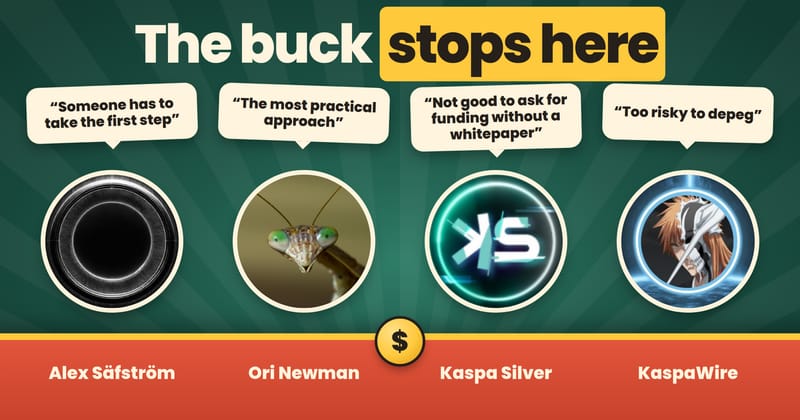
Other core developers lined up behind him. Michael Sutton promised to help with "any protocol-level obstacles", and Ori Newman wrote that a decentralized stablecoin is "probably the most practical approach to kickstart the Kaspa defi market" (post).
For eleven days there was a fundraiser but no detailed design, and the questions piled up. The full design went up on 3 November, and the whitepaper with the proofs follows on 8 November.
Why Kaspa needs its own dollar
Kaspa can now run tokens and contracts on its main chain, but there's no dollar on it. A trader who wants to lock in profit has to leave the network. A DEX on the main chain can only pair KAS against other coins that swing just as much, and there are no dollars to lend or borrow.
Säfström says he spent six months asking the companies behind big stablecoins to come to Kaspa. They held back, for two reasons. They expect too little volume, and the tools they need don't exist yet. He calls it a chicken-and-egg problem and wants to break it from the other side, by building a dollar first. "Create a decentralized native stablecoin, build the DeFi, show the volume, and then the issuers come," he wrote (thread).
How USDT and USDC work
USDT and USDC are promises from a company. You give Tether or Circle a dollar, they keep it in a bank or in short-term US government debt, and they give you a token. The token is worth $1 because the company will buy it back for $1. About $297 billion of stablecoins are in circulation, $179 billion of it USDT and $71 billion USDC (DefiLlama).
This works well most days. The catch is that you trust one company and its bank. In March 2023 Circle had $3.3 billion of USDC reserves stuck in Silicon Valley Bank when it collapsed, and USDC fell to about 87 cents until the US government guaranteed the deposits (Federal Reserve).
The company can also freeze your coins. Tether can blacklist an address and wipe its balance, and in 2025 it froze about $1.26 billion across more than 4,000 addresses (BlockSec). Most of that money was linked to crime and scams, and regulators want issuers to have this power. It still means a company decides whether your balance can move.
Borrowed into existence
KaspaDollar has no company and no bank account. Every coin starts as a loan. You lock your own KAS in a vault, a contract on the Kaspa main chain, and borrow new dollars against it. Its working name is KSD, and the final ticker may change.
You always lock more than you borrow. To mint, your KAS must be worth at least 2.5 times the loan. Put in $250 of KAS and you can take out 100 KaspaDollars. You keep your KAS, and if its price rises, the gain is still yours. When you want the KAS back, you return the 100 dollars and they are destroyed.
If KAS falls 20%, your $250 of KAS is worth $200, twice the loan. That is the danger line. Below it anyone can step in, repay part of your loan and take the matching KAS plus a penalty of a few percent. Take a vault with $36,600 of KAS and $14,640 borrowed. If KAS falls 25%, a liquidator repays about $1,926 of the loan, the vault drops back to twice its debt, and the owner loses $96 to the penalty. Add KAS or repay in time and it never happens. Between 200% and 250% the vault is safe but locked, so you can't borrow more or take KAS out.
Most people would never open a vault. If you only want dollars, you'd buy KaspaDollars from someone else, the way you buy USDT today. You could also hand any KaspaDollar back to the system and get exactly $1 worth of KAS from a vault of your choice. That swap is what keeps the price near $1. If it trades at 97 cents, people buy it cheap and swap it for a full dollar of KAS. If it trades above $1, vault owners mint more and sell.
Only KAS can be locked as collateral. Säfström has said he'd look at a staked version of KAS later, but that it "doesn't come without risks" (reply). There are no developer fees, and once the code goes live on mainnet it can't be changed.
One thing doesn't go away. Every token on Kaspa still needs a little KAS to pay network fees, which we covered in Who pays the KAS? A KaspaDollar wallet will still need some KAS in it.
Miners as the price feed
A contract can't look up the price of KAS by itself. Someone has to tell it, and that someone is called an oracle. Many decentralized stablecoins rely on outside price reporters for this. KaspaDollar wants Kaspa miners to do it instead.
Each miner can write a KAS price into every block it mines, using a small plugin that reads prices from public exchanges. The system takes the last ten minutes of blocks and uses the middle vote. Anyone can post that price to the vaults, together with a zero-knowledge proof that the votes really came from those blocks and none were added or left out. The poster and the miners who voted close to the middle share a small fee, paid by the people doing liquidations. For miners that's extra KAS with no stake and no new hardware.
A ten-minute window only counts if at least half its blocks carry a vote. To push the price away from what honest miners report, a cheater needs half the votes. If every block votes, that's half of all mining power, comparable to a 51% attack on Kaspa. If only half the blocks vote, a quarter of the mining power is enough. There's a brake too. The price used for liquidations can fall by at most 25% an hour, so a fake crash takes hours and vault owners have time to get out.
A cheating miner loses only the fee. What stops an attack is the cost of mining power, miners leaving a pool that cheats in public, and the fall in the KAS price that would follow. The design also only works if enough mining pools install the plugin, and the number needed before launch hasn't been set (How it works).
What a crash would do
KaspaWire argued that 2.5 times isn't enough if KAS falls 80% and proposed a reserve built from fees.
Säfström answered that 2.5 times covers a 60% fall "within one liquidation opportunity", and that liquidations would happen within seconds of a price move.
The worst case is a crash when nobody can liquidate. If no fresh price arrives for 30 minutes, borrowing, withdrawing, liquidating and the $1 swap all stop. Repaying and closing still work. If KAS then falls by more than half before prices come back, the vaults nearest the line hold less KAS than they owe. Nobody else pays for that hole. The system doesn't spread the loss across other vaults or print anything to cover it, so KaspaDollar would trade below $1 until the bad loans are repaid. If prices never return, after 30 days anyone can trigger a final settlement at the last good price. Holders then swap their KaspaDollars for KAS with no fee, and vault owners take back whatever is left over.
This is where history matters. DAI on Ethereum is the best-known stablecoin of this kind, and Säfström points to its nine years of service (reply). It had one very bad day. In March 2020 ETH fell more than 40% in hours while Ethereum was jammed. Liquidation bots couldn't get through, and a few traders bought about $8.3 million of ETH from vaults for nothing (CoinDesk). KaspaDollar's pause is meant to stop exactly that. When the price feed goes missing, the vaults freeze instead of being sold off cheap.
Its closest cousin is Liquity's LUSD on Ethereum, which also can't be changed, takes one kind of collateral and lets anyone swap 1 LUSD for $1 of ETH (Liquity). Liquity liquidates below 110%. KaspaDollar draws the line at 200% to leave room for big KAS swings.
It has nothing in common with TerraUSD, which collapsed in 2022 and wiped out about $45 billion in a week. Terra's dollar had no locked collateral at all. It was backed by LUNA, a coin the same system printed, and when people ran, LUNA was printed into nothing.
The doubters
The most read criticism came from Kaspa Silver, who explained why they hadn't donated (post). They didn't like being asked for money before a whitepaper, wanted the effort to go into bringing USDT and USDC to Kaspa, and worried that a coin nobody can freeze will struggle with regulators and exchanges.
Säfström answered point by point. He agreed it's fair to wait for the whitepaper and said the fundraiser opened early mostly to get attention. He reads European and US stablecoin law as written for companies that issue coins, and KaspaDollar has no company. He pointed out that DAI can't be frozen today and still trades on Binance, Coinbase and Kraken. And he called KaspaDollar "indirectly an effort to bring USDC/USDT onchain", because it builds the tools and the first volume those companies say they're waiting for.
KaspaScopio took the middle ground. Waiting for USDT or USDC "might not get us anywhere", KaspaScopio wrote, but still wants the whitepaper before donating. "Wanting to understand what we're funding isn't a lack of support" (post).
No court or regulator has ruled on a dollar with no issuer yet. Säfström's reading of the law is his own, and DAI's exchange listings show where things stand today, not where they'll stay.
Where the 5 million KAS goes
The donations don't back a single KaspaDollar and aren't trading money. They pay for the work. Of the 5 million, 3.6 million KAS goes to development, building ties with wallets, exchanges and integrators, conference travel and marketing. The other 1.4 million KAS pays for an outside audit, a second review of the fixes, published reports and a bug bounty. Every payment out of the address is to be listed at the end of each month.
Plenty of people asked why the existing Kaspa development funds don't simply pay for it. Säfström says the Rust rewrite and DAGKnight money is already promised to the people building those, and the community fund of about 1 million KAS goes to smaller projects (reply). Kaspa Bots would only fund it through a Delaware company, which he says doesn't fit a project meant to have no owner (reply).
If you donate, send from your own wallet. A refund goes back to the address that sent the KAS, and an exchange withdrawal address belongs to the exchange. Exchange donors have to email their withdrawal confirmation and prove the transaction, and refunds aren't guaranteed (refund terms).
Säfström also expects the vault contracts to be reused as templates for other stablecoins on Kaspa, and the plan includes a zero-knowledge bridge to Ethereum-style chains, which some of the big issuers want before they'll build here (reply).
If the money comes in, building runs from January to April. In May the whole system goes on testnet, with miners running the price feed for a month. An outside audit follows over the summer, and mainnet is planned for September 2027. The code isn't public yet. Before any of that, the whitepaper on 8 November has to prove the numbers behind the 2.5x rule and the miner price feed.