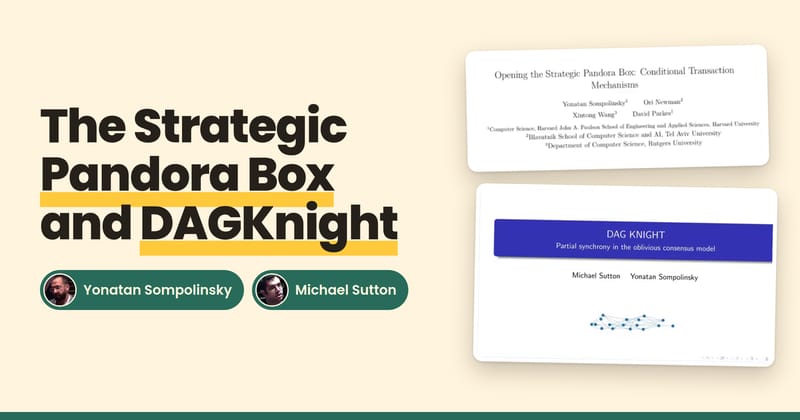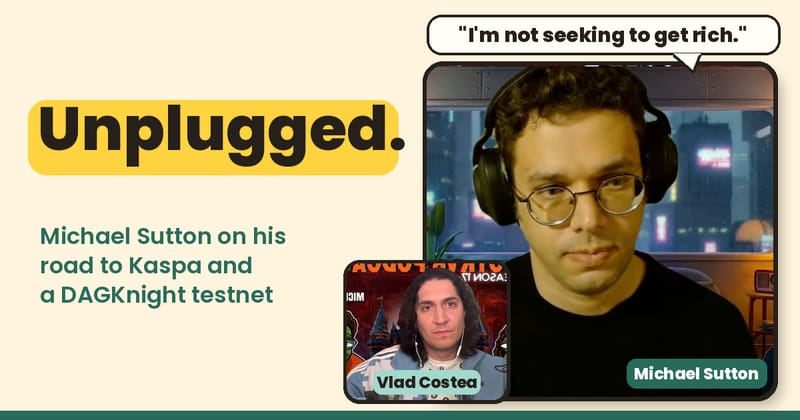
Michael Sutton rarely talks about himself. For three hours on Vlad Costea's Bitcoin Takeover podcast, in a live stream that ran until midnight for both men, he did. The Kaspa core developer and co-author of the DAGKnight paper told how Yonatan Sompolinsky recruited him over lunch at university, how he helped keep the young network running in its rough first months, and why he has never thought about leaving.
He also brought news. He still expects DAGKnight on "a stable and secure testnet" before the year is out, with a big release of materials "in a few weeks when it's all ready".
Costea had planned the interview for more than a month before conferences got in the way. The full recording is on YouTube, and each player below starts where the topic begins.
A GPU researcher meets Sompolinsky
Before crypto, Sutton studied high-performance computing. He was finishing a master's degree at the Hebrew University of Jerusalem, writing programs for graphics processors and designing parallel algorithms for graphs. That work became a published paper. With Tal Ben-Nun and Amnon Barak he wrote Afforest, a method for finding which points in a huge network are connected, which ran up to 67 times faster than earlier methods on processors and up to 23 times faster on graphics cards. It is now the connected-components code in the GAP Benchmark Suite, a standard set of tests researchers use to compare graph software.
He met Sompolinsky on an advanced communications course. "He came up to me at the cafeteria and just asked if I joined his startup, which is implementing his Ph.D." Sutton said he can't remember the exact conversation and couldn't join right away. He started about a year later at DAGlabs, the startup that went on to found Kaspa.
His way into Bitcoin was backwards. Reading Sompolinsky's research, he followed the references back to the Bitcoin white paper, around 2018, and "had the aha moment" there. Then he went back to Sompolinsky's papers and "enjoyed very much the beauty of them".
Rollups before launch, and a rough first year
His first project at DAGlabs, two or three years before Kaspa launched, was a design for layer-two networks on top of Kaspa. Zero-knowledge proofs weren't practical yet, so he sketched something close to Arbitrum. Work runs off the main chain, and if anyone disputes a result, the two sides narrow the argument down until the main chain only has to check a few instructions. He wrote it up as "a very basic yellow paper" and moved on. One of the questions he moved on to led to DAGKnight. He called the return of layer-two work to Kaspa today "a circle closed".
Before launch he was mainly a researcher. After launch he became an engineer, because the network needed one. "It didn't run smoothly from the start. There were hiccups." Tests with a handful of nodes, he said, can't prepare you for a real worldwide network at one block a second. He spent the first half year helping to stabilise it. His first big project after that was proposing to rewrite the node software in Rust. The result is Rusty Kaspa, the main node software today, and its speed is what made 10 blocks a second possible. In 2022 he also started a Kaspa 101 blog series that explains blockDAGs in simple language.
The DAGKnight paper came out in 2022, a year after launch. It waited because other things mattered more in the short term, above all giving Kaspa programmability.
Why he never left
Costea set what he called a loyalty test. Sutton has been with Kaspa for about eight years. Wouldn't he have earned more at Arbitrum or on a ZK rollup team? Sutton said he wasn't sure he would have, and that the thought never crossed his mind. He spoke about his partnership with Sompolinsky, "He as an advisor, me as a younger researcher. We're a good complement to each other." He also spoke about being "a part of a bigger revolution". "I'm not seeking to get rich. It's not the point."
He believes Kaspa "earned the right to succeed at a much higher scale than it does today". Either Kaspa succeeds, he said, or its ideas will shape some future wave, because they are already "part of the common knowledge of crypto now".
Would he switch to Bitcoin if it turned on covenants? He called himself "third generation" in crypto. Sompolinsky, in his telling, is second generation, and Sutton doesn't carry "the weight of seeing the first generation". He added that "we need him to step up and lead more with his vision". He said he could imagine contributing to a Bitcoin that was "much more flexible", and that he finds more of the researchers he appreciates in Ethereum and Zcash than in Bitcoin. His problem with Bitcoin research is the habit of "solving problems that shouldn't be solved". Bitcoin's script rules are fixed, so developers hunt for clever ways around them. "I don't like the idea of rules of nature which aren't real and are kind of forced."
He tied this to covenants, rules that travel with coins and limit how they can be spent. Someone on X had sent him a screenshot of Greg Maxwell calling covenants "an amusingly bad idea" and asked how Kaspa made them a good one. Sutton's answer was to do the simple thing in the base layer. On Bitcoin, a covenant that has to prove where it came from must carry a copy of the transaction before it, then check the one before that, a proof he called "not so cheap" and hard to combine. Kaspa added a covenant ID through KIP-20, a 32-byte tag the network itself tracks. A new coin can carry the tag only if a coin already inside the covenant approves it, so the family line is checked inside one transaction. Our covenants explainer covers why that line matters.
A DAGKnight testnet before the new year
The testnet question came from a viewer who wanted to know when people would see a testnet or production code. Sutton said the work now moves on three fronts that feed each other. The first is finishing the full proof of the protocol, which still changes small details. The second is a "yellow paper" that writes the algorithms in a language closer to code. The third is the code itself. He first made the testnet promise on X in October, and on the stream he said "I still think so."
The current push started at what he called a "secret" core retreat in the Netherlands, which Sompolinsky joined after a summer road trip with Costea through Romania. "It was the kickoff for DAGKnight, essentially, for the main effort for DAGKnight." He gave credit to coderofstuff, who had been building DAGKnight long before that and stayed away from the meeting to keep a pseudonymous identity.
The code side is visible on GitHub. The dagknight branch of Rusty Kaspa holds 130 commits that are not in the main branch yet. The day before the interview, coderofstuff's renaming and colouring change became the first merge into that branch since early September. A change to how DAGKnight breaks ties between competing block histories, from developer Maxim, is still open. DAGKnight is not part of any Rusty Kaspa release.
Sutton gave a short version of what DAGKnight changes. Every proof-of-work network has to order its blocks, and the order decides which of two conflicting payments counts. Bitcoin and GHOSTDAG, the protocol Kaspa runs today, both carry a built-in guess about how long a block takes to reach other miners. Confirmations are paced by that guess, and if the real network ever gets slower than it, security breaks no matter how long you wait. DAGKnight doesn't need the guess. That lets it confirm as fast as the network really is and keeps it safe when the internet gets slow. Our Mid-Chain report covers his longer talk on the design.
One viewer asked whether DAGKnight would keep Kaspa running if undersea internet cables were cut. Sutton separated two cases. Slow links, where a message still arrives after tens of minutes, are what DAGKnight is built for. A split lasting days is different. DAGKnight would be one ingredient, but the network would also need a way to settle which side's payments count once the halves reconnect. "The first goal, I'd say, for DAGKnight would be to target a situation where the internet is very noisy, and tolerate that."
Twenty blocks a second is already in reach
Kaspa produces 10 blocks every second today. Sutton said the current software could already run at 20, "but it's still an effort and it requires a lot of testing." The limit isn't raw speed. A node has to stay well inside its hardware, because a new node joining the network must catch up on days of blocks while new ones keep arriving.
Costea asked what 100 blocks a second would take, a target a Bitcoin developer once named to Sompolinsky as impressive. Sutton said faster internet isn't the answer. Each block header is a sample of proof-of-work from a miner, and each one costs the node processing time. Getting to about 25 blocks a second would mean making headers cheaper to handle. "But going to 100 requires another, more R&D."
The point of 100 wouldn't be more room for transactions. With 100 blocks every second, the network collects 100 samples a second from the miners around the world. If miners vote on something, a second or two is enough to know what the majority thinks. Sutton calls this real-time decentralization. At the end of the show Costea argued that extra capacity nobody uses yet only makes things harder. Sutton agreed about capacity and held his ground on speed. "It's not about capacity, though. It's only about the frequency."
An enabler first
When Costea asked what the community should build, Sutton said he sees his own job differently. "I'm seeing myself as an enabler first. I don't claim to have the creativity to know exactly what people will develop over this." That is why he wrote Argent, the language for apps made of several contracts, after finding SilverScript too low-level for bigger designs. It started with a chess game written as contracts, which he has never deployed.
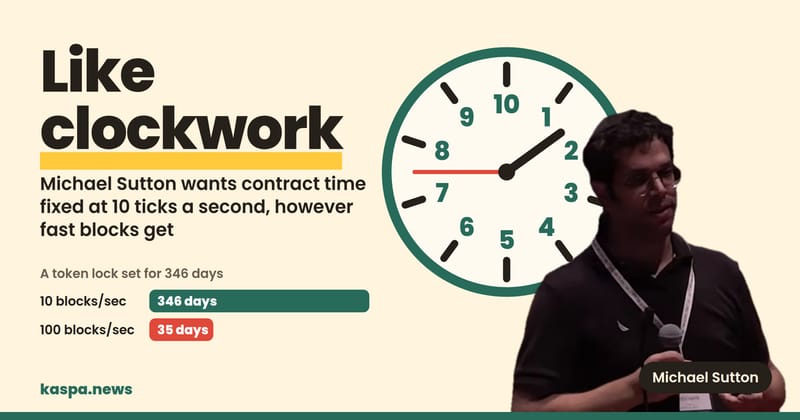
He picked chess to show something most chains can't do, which is blitz chess, where each move must come within seconds. A chain with one block a minute can't measure ten seconds. Kaspa ticks ten times a second, so it has a clock fine enough to time moves. He also mentioned that a colleague, whom he didn't name, has built an unpublished game of pong where players move the paddles with transactions on the chain.
He listed what people are building now. Someone is building an order book exchange. Someone else is designing a prediction market on covenants. There is the KaspaDollar, a design for a stablecoin no company issues, and kUSDT, a bridged version of USDT. Others are working on bridges to Ethereum. With zero-knowledge proof checks now on Kaspa, he said, a contract can verify that Ethereum blocks are final, and Ethereum can check proof of Kaspa mining. Bridges are on his own mind. "I've been trying to think about what bridge would bring a lot of value to Kaspa." He offered to join a Zoom call with anyone who wants his input, and admitted he might build an app of his own, "which I'm not going to tell anyone about it probably until I actually deploy it."
AI in the lab
A viewer asked how much core development is done with AI. Sutton said it differs for each developer. On the node software he works "on a very granular level" and inspects every commit. In research it has changed everything. He said he uses OpenAI's models, and for turning an abstract algorithm into a detailed plan before coding, "which is something we do a lot with DAGKnight now", Astra is "amazing". He praised its ability "to analyze complexity, to not make mistakes, like literally no mistakes", and said it runs its own audits with sub-agents without being asked.
In harder research he still feels like "the responsible adult". He called the model "a very eager student, very fast", which still needs steering away from dead ends. The biggest change is in small questions. A check that would have cost two days, and so was never done, now takes five minutes.
He expects people to stop reading every line of code one day, the way nobody reads the assembly a compiler produces, but only once AI can formally prove the code does what it should. "Some people are scared, I understand the fear," he said, but he is fascinated. "The sea of knowledge is more approachable. It's still infinitely large, but you can do a bit more than playing with rocks on the sand." The worry he shares with Costea is dependence. If the big AI companies stopped their services, many programmers wouldn't know how to go back, and "the only thing you can rely on is competition."
The same tools changed security work. Costea described a year of hacks found by AI. Sutton said a core team has to "scan before the attacker" and that this has been "a big weight". Asked whether anything serious turned up in Kaspa, he said there was no consensus bug, "only node crashes and stuff like that", and that the node "is definitely more resilient now".
A payment test that stalled live
Costea had claimed that AI companies don't take crypto. When he found that NanoGPT, a pay-as-you-go service that resells access to AI models, accepts Kaspa, he put a NanoGPT payment address on screen and asked viewers to send a dollar or so.
The KAS arrived at once. Within minutes Sutton, watching a block explorer, reported four payments worth 161 KAS. One address soon held 683 KAS, part of it sent by Sutton himself from KaChat, a chat app that runs on Kaspa transactions. NanoGPT credited none of it. One payment showed as "transaction failed" and another as not yet credited. By the end of the show viewers had sent more than 1,000 KAS, which Costea put at about $30. Sutton pointed out that nothing could have failed on the network's side, because NanoGPT could only have seen the payments if they were already on the chain. A viewer suggested NanoGPT expects the exact invoice amount and rejects anything else. Costea said he would contact NanoGPT's support and make sure everyone gets refunded.
Costea drew a different lesson from it. Kaspa viewers answered the call at once because they keep small amounts in wallets they actually use. Bitcoin holders, he said, would mostly have answered that their coins were in cold storage.
Sutton then gave a short tour of KaChat, which he said Kaspa Silver now maintains. Two people exchange encrypted messages as transactions and can send KAS from the same chat. By the end of the stream Costea had installed it, a viewer had funded his wallet with 100 KAS, and someone had sent him a name, takeover.
Light mode, C++ and a rocket launcher
The long stream showed a side of Sutton that rarely comes up in his posts. When Costea floated a game idea, Sutton had to ask what an RPG was. He knew the word only as a weapon, and Costea had to explain that it means a role-playing game. "I'm not a gamer," Sutton said. He played simple computer games as a child and nothing modern.
His first programming language was C++, taught on his undergraduate course around 2011 or 2012, in Visual Studio 2010. Looking at the dark kaspa.org website, he admitted something unusual for a developer. "Dark is fine, but I can't code in dark. I don't know why. Most people code in dark, I can't."
He doesn't own a Mac laptop, and he doesn't mine Kaspa, at least not yet. Mining would take time he would rather spend on Kaspa itself. That may change. Miners can now write data into the blocks they mine, and that data can be gathered into a kind of oracle where miners report what is happening in the world. The KaspaDollar plans to use miners this way. "Once Kaspa is used for RTD and there's a real system using it, I will want to mine myself," he said, and he would buy an ASIC to add to the network's decentralization.
Emission and a node at home
A viewer asked about emission, the new KAS paid to miners, which shrinks over time. "Of course, anyone is concerned," Sutton said. He called it the main motivation for everything he has done in the last year and a half. The goal is enough use and fees for the network to pay its miners "without printing more money, so to speak".
To run a node, he recommended 16 GB of RAM, an SSD of half a terabyte to a terabyte for safety, and at least eight processor cores, because the software does much of its work in parallel. Costea concluded that a $1,000 laptop can do it. "Yeah, definitely," Sutton said. The team moved to 10 blocks a second only when it knew ordinary hardware could keep up.
On privacy, he said shielded payments like Zcash's are possible on Kaspa now that it can verify zero-knowledge proofs. Kaspa can check a full STARK proof directly, a kind that needs no trusted setup and resists quantum computers. Such a proof is big, though. One fills a whole block, so the network could verify about ten a second.
What success looks like
Sutton's answer to the closing question started with usage. Kaspa could succeed as a peer-to-peer payment network with enough volume, he said, but he thinks fast proof of work offers more. His longer view is of high-frequency ordering as a backbone of the internet, the way TCP carries messages between computers, "the ultimate sequencer". He doesn't think a coffee payment uses what the network really offers, though it is fast enough for that. Before any of this, he said, Kaspa needs smaller product wins to build volume and liquidity. "You can't win the big wins first."
Viewers in the chat kept pushing him on why Kaspa has so few users. He said the tools to use programmability properly took longer than the network upgrade itself, and that some core developers now build apps. The KaspaDollar is led by a core developer, Alex Säfström, and others work on a prediction market. "They want it to be secure, they want it to be audited, that's just the facts," he said, and he wasn't going to apologise for it. "In general, I act under the almost, say, very definite belief that Kaspa will succeed."
Asked what he will do when Kaspa is finished, he said he would stay around. He hopes for a day when the ongoing research doesn't hold him so tightly and he can work on his own ideas on top of Kaspa. He closed with a message to the community. "I love you all," he said, and he called even the constant critics "a sign of care". "So let's all keep pushing, and we can build a lot of interesting stuff over Kaspa now. So go ahead and do it. Don't wait for others."