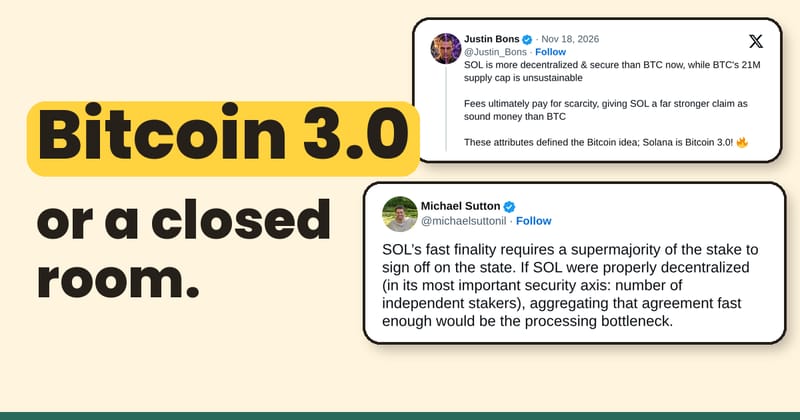
At Breakpoint in London, Solana shared a clip of Cyber Capital founder Justin Bons calling Solana "the best shot we have at Bitcoin 3.0" and saying it fulfills Satoshi Nakamoto's original vision (Solana post). In a follow-up post, Bons argued that SOL is now more decentralized and secure than Bitcoin, and that Bitcoin cannot keep paying miners once its 21 million coin cap runs dry (Bons post).
Speed alone was never Satoshi's breakthrough. Card networks and private databases have settled transfers quickly for decades. Satoshi's benchmark was decentralized peer-to-peer payments that let anyone send money directly, fast and safely, without handing control to a bank, a clearinghouse or a small circle of known signers.
That benchmark brought Kaspa core researcher Michael Sutton into the thread. Replying directly to Bons, Sutton wrote that fast finality on Solana depends on a supermajority of staked coins signing off on each block. If that stake were genuinely spread across a wide crowd of independent stakers, Sutton wrote, "aggregating that agreement fast enough would be the processing bottleneck," calling it "a tension which seems unavoidable in the PoS model."
What Michael Sutton actually means
Sutton unpacked the mechanics in an earlier essay he linked beside his reply (Sutton on fast proof of work). Settling a payment quickly has two separate parts. First comes fast inclusion, meaning how quickly a transaction enters a block. Second comes fast confirmation, meaning how quickly reversing that transaction becomes impractical. Many networks can speed up the first step, while the clash with decentralization hits the second.
Proof of stake works in a "select-then-work" order. Everyone knows which validators hold the voting keys before a round starts, and the network has to gather signatures from a supermajority of those keys before a block locks in. Spread voting stake across tens of thousands of independent operators around the world, and waiting for enough signed votes to cross the network turns into a traffic bottleneck. Every extra independent voter adds another message the protocol must collect before the clock stops.
Ethereum avoids shrinking its validator count by picking small rotating committees from its staker pool to vote on everyone's behalf. That keeps participation wider, yet brings a different weakness. Because committee members are selected before they vote, an attacker knows which referees to target ahead of time. A committee sign-off also backs a block with a sampled subset rather than the full weight of all staked coins.
Proof of work reverses the order into "work-then-select." Miners race independently with hardware and electricity, and nobody knows who found the next block until the work is already complete. Each valid block carries direct mathematical proof that its finder outworked the entire network's hash power. Nothing waits for a roster of voters to gather and sign a certificate, so adding 10,000 more independent miners in more countries adds zero voting traffic and keeps confirmations just as quick.
How Kaspa brings fast proof of work to peer-to-peer payments
For years, fast proof of work sounded impossible because Bitcoin keeps blocks in a single chain. Messages take roughly 200 milliseconds to travel around the earth. If miners on a linear chain produce blocks faster than that round trip, two honest miners find valid blocks at the same time, and the network throws one block away. That limit kept Bitcoin slow and left faster payment rails to proof-of-stake designs.
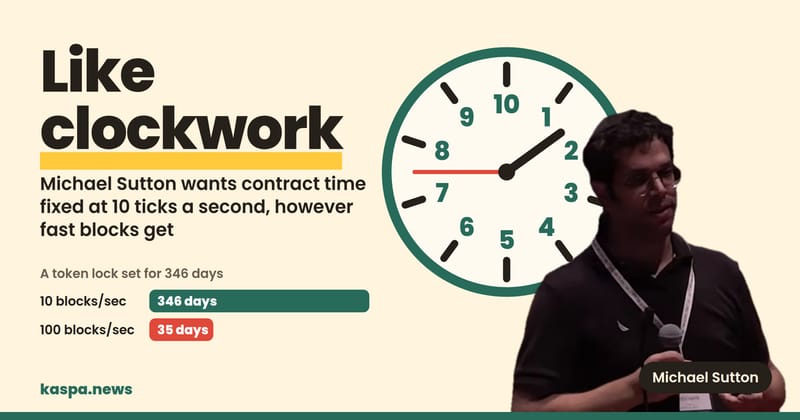
Kaspa broke past that wall by changing the shape of the ledger instead of replacing miners with a voting committee. Rather than discarding blocks that arrive at the same moment, Kaspa keeps parallel blocks together in a blockDAG and puts them into one agreed order. Today Kaspa runs at 10 blocks per second, a 100-millisecond interval faster than a global internet round trip, without forcing miners into one region (Sutton on 100 ms blocks, Rusty Kaspa block-rate parameters).
For everyday peer-to-peer payments, that difference changes who holds power during the second you hit send. As Kaspa founder Yonatan Sompolinsky explained on Bitcoin Takeover, chains that assign a single leader to each slot still leave your transaction briefly in the hands of one or two scheduled validators. Parallel proof of work lets many independent miners publish blocks simultaneously, so no single slot leader stands at the gate.
A KAS payment normally enters a block within about a second, and its safety builds over the next several seconds as honest miners pile more proof of work on top. Developers are also testing DAGKnight, an upgrade meant to replace fixed network-delay assumptions with an adaptive model, with Sutton expecting a stable testnet before the year ends (kaspa.news interview).
Default pruning also discards old history so ordinary home nodes can verify the rules without data-center hardware (earlier kaspa.news comparison).
Ethan Anvel summed up the participation divide in two lines after Wall Street entered the Solana conversation in London.
Solana's own rules prove the bottleneck
Solana just ran the real-world test of Sutton's argument. Last month, the network switched live to Alpenglow, a new voting engine built by Anza (Anza Alpenglow overview, SIMD-0326), and cut target slot times in half to 200 milliseconds (SIMD-0525). Moving votes off the ledger lets blocks finalize in roughly 150 milliseconds when 80 percent of active stake agrees in one round, or 60 percent in two rounds.
Buying that 150-millisecond clock meant narrowing the voting room in protocol code. Alpenglow lowers its limit for cheating stake from 33 percent to 20 percent so it can close blocks faster and survive 40 percent going offline.
It also caps active validators at 2,000 so vote certificates fit in one small network packet, and burns a 0.8 SOL Validator Admission Ticket each epoch, about $55 every 26 hours or $18,500 a year at CoinGecko's $68.83 SOL price on 20 November 2026 (SIMD-0357).
Alpenglow engineers Wen Xu and Roger Wattenhofer explained that burn bluntly, writing that every extra validator multiplies messages across the cluster, making the ticket "an economic barrier to having too many voting validators." Hardware stacks another wall on top, calling for at least 12 fast CPU cores, 256 GB of RAM and multiple enterprise NVMe drives on bare-metal servers (Agave validator requirements). Median active stake sits at 160,485 SOL, roughly $11 million (Stakewiz).
Live mainnet numbers from epoch 1092 show how tight that circle already is. Just 662 active validators, plus 23 delinquent ones, secure 428.9 million staked SOL, down from 699 four days earlier (Solana Compass).
Eight validators alone, Helius, Figment, Binance Staking, Bitwise Onchain Solutions, Kraken 2, Jupiter, Ledger by Figment and Everstake, hold 21.6 percent of stake, already above Alpenglow's 20 percent safety threshold. Twenty-five vote accounts hold 40.5 percent, enough to stall two-round finality, while Figment and Kraken each operate two spots inside that top 25.
Geography matches the math. Anza notes that which voting path wins "depends on where you are in the world" (Anza Alpenglow overview), because crossing oceans slows 200-millisecond slots. Stakewiz server records put 61.1 percent of all staked SOL inside Frankfurt, nearby Limburg, Amsterdam and London, against 14.3 percent across the entire United States. A single host, TeraSwitch Networks, carries 25.1 percent of staked SOL on its own.
Inside that institutional room, Wall Street fits naturally. At Breakpoint, Hester Serafini, president of ICE Clear Europe at New York Stock Exchange parent Intercontinental Exchange, said a NYSE venue already accepts Solana tokens and ICE is exploring running a Solana validator. ICE gave no timeline, and its own post-trade ledger was described earlier as a separate permissioned system (Solana Compass).
One new Wall Street validator could not rewrite Solana by itself. Even after Solana stopped for nearly five hours on 6 February 2024, restarting took engineers shipping a fix and staked operators agreeing on a snapshot (Solana outage report). What Breakpoint showed is how close 150-millisecond proof of stake already looks to an institutional data-center club.
Paying for open money over the long run
Open proof of work still runs on real-world competition rather than charity. Mining Kaspa requires specialized ASIC machines and cheap electricity, and individual miners route much of their hash power through mining pools. Even so, anyone can plug in hardware or move between pools at any time without asking permission, burning an admission ticket, clearing a 2,000-seat cap or gathering millions in delegated coins.
Bons also pointed at the genuine economic test ahead for every supply-capped proof-of-work network, including Bitcoin and Kaspa, where nearly 97 percent of the 28.7 billion KAS supply is mined and block rewards step down each month. When coin issuance shrinks, transaction fees must pay for hash power. As Sutton argued on Bitcoin Takeover, high-capacity peer-to-peer payments and real on-chain volume are how Kaspa aims to earn those fees while keeping block production open to anyone (kaspa.news interview).