Vitalik Buterin has a new name for where Ethereum is heading. In an essay published on 27 September, he describes a "cryptographic world computer" and argues that the network Ethereum is turning into is called a blockchain "to a large extent for historical reasons". In his telling it is really "a hybrid construction", one that merges "core Satoshian ideas" with "new powerful cryptographic machinery" that did not exist, or was not mature, when Bitcoin launched (essay).
It is an elegant essay, and for anyone who follows Kaspa it is also a strangely familiar one. It describes a base layer that mostly puts transactions in order while apps prove their work elsewhere, many block producers where there used to be one, work split into self-contained pieces that can run in parallel, and speed treated as a design goal. Kaspa researchers have written about each of these, some of them for years, and several already run on Kaspa. The essay doesn't mention Kaspa, and it doesn't need to. Read side by side, the two show how far good ideas travel.
The Satoshi half and the cryptography half
Buterin sums up the original blockchain recipe in a single breath. "Everyone tries to make the next block with valid PoW, one guy succeeds, broadcasts it, everyone else downloads it and re-executes, repeat." Ethereum set aside the first ingredient, proof of work, in 2022, and the world computer is the plan for most of the rest.
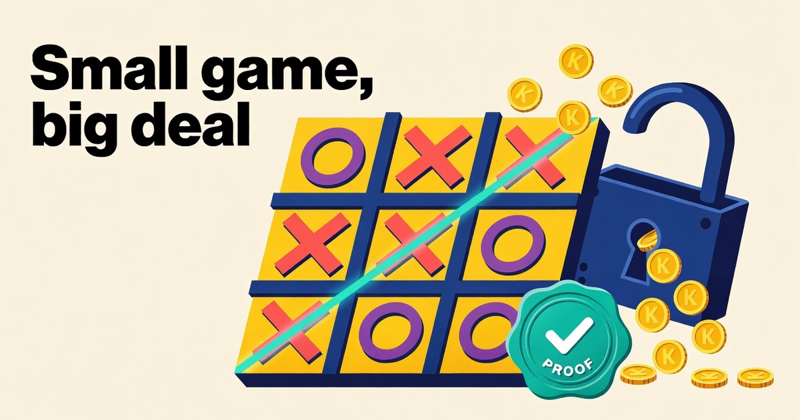
Kaspa took the other road from the same starting point. It kept proof of work, the most Satoshian idea of all, and brought the cryptography to it. Since the Toccata upgrade activated on 30 June, Kaspa mainnet has been able to check zero-knowledge proofs inside ordinary transaction scripts, through an instruction called OpZkPrecompile (Toccata release, KIP-16). The first app built on it, Maksim Biriukov's tic-tac-toe game, which kaspa.news covered on 26 September, still runs on testnet-10 with test coins (kaspa.news on the game). The instruction accepts two kinds of proof, Groth16 and RISC Zero's STARK-based receipts, which the proposal describes as quantum-resistant (proof types).
Buterin also wants the whole of Ethereum to become quantum-safe, and on Kaspa testnet developers have reported spending coins from vaults locked with hash-based signatures, the kind built to withstand quantum computers (kaspa.news on post-quantum vaults).
The two projects share more history than it might seem. Ethereum's 2014 whitepaper used a modified version of GHOST, a rule for choosing between competing blocks published in 2013 by Yonatan Sompolinsky and Aviv Zohar, and proof-of-stake Ethereum still picks its blocks with a rule named LMD-GHOST (whitepaper, Gasper).
Sompolinsky took the idea much further. In 2018 he and Zohar published PHANTOM, a design that keeps every block miners find at the same moment instead of discarding all but one. Its practical form, GHOSTDAG, was later refined (PHANTOM and GHOSTDAG paper), and Kaspa has run on it since late 2021 (Kaspa genesis). Strictly speaking, Kaspa was never a blockchain at all. It is a blockDAG.
Many hands on every block
The second ingredient, "one guy succeeds", is where the two plans meet from opposite directions. Buterin's table of changes swaps "single miner makes block" for "multi-party block construction". Ethereum will get there with FOCIL, arriving in the Hegota upgrade in 2027, in which a committee of 16 validators lists the waiting transactions it sees and the rest only vote for blocks that include them (FOCIL, Hegota plan).
On Kaspa, many parties already contribute to every moment of the ledger. Blocks found by different miners at the same time are all kept, and since the Crescendo upgrade in May 2025 the network has produced ten of them every second (Crescendo guide). Sompolinsky describes the aim as "decentralizing each consensus round rather than chain quality achieved through a coarse aggregate of rounds" (Sompolinsky).
He also has a one-line explanation of why this comes naturally to mining. "pos=select then write, pow=write then select." In proof of stake, the protocol first chooses who makes the next block, and that producer then decides what goes in. A miner fills its block first and only learns afterwards whether its work wins, so nobody holds a given moment of the ledger in advance. Ethereum is adding committees to share that moment out. Kaspa gets the sharing from the mining itself.
Buterin makes a related point about why decentralisation is starting to pay for itself. The network of many machines, he writes, is shifting from "purely a burden incurred in the name of safety and robustness" toward, "in a few limited cases", "a strength even from a performance perspective". On Kaspa that shift is built into consensus, because more blocks mean a more accurate sample of the honest majority. By Sompolinsky's figures, a miner with 37% of the hashrate would produce most of the blocks in a one-second window with a probability of 12% at ten blocks a second, and 0.3% at 100 (Sompolinsky essay).
Real-time, two ways
Speed is where the two philosophies are easiest to see side by side. Buterin writes that Ethereum "will never have latency that competes with servers", and expects infrastructure built around the chain to supply it. His 2030 targets for the base layer are slots of roughly 4 to 8 seconds and finality in about 8 to 32 seconds. The quick experience comes from the layers around a steady core.
Sompolinsky puts the line somewhere else. "realtime is speed, and 'realtime decentralization' achieves it in a decentralized manner," he wrote in March (Sompolinsky). In a February essay he described the goal as a consensus system with "the same model and security guarantees that bitcoin's pow embodies, just in real-time". "Transactions that can confirm safely after an hour in bitcoin, can do so in seconds on kaspa," he wrote. Censorship resistance keeps the same clock. "if bitcoin guarantees censorship resistance in the course of an hour, kaspa guarantees it within seconds", which in his words offers "the UX of the internet with the security and decentralization of bitcoin" (Sompolinsky essay).
Real-time, in his sense, is not a stopwatch reading. "While real-time rhymes with fast, fundamentally it is not wall-clock time rather real system time," he explains. A protocol built this way runs as fast as the network allows, "fast in peace days and slow yet all the same secure when the internet breaks down". Kaspa makes a block every tenth of a second today. His targets go further, 25 to 40 blocks a second with the DAGKnight upgrade, a consensus design he created with Michael Sutton, and 100 a second in a hard fork aimed at 2027 (Sompolinsky essay, DAGKnight paper).
Order on the chain, work off it
The heart of the world computer is a new division of labour. In Buterin's own definition, it is a shift away from Ethereum as "solely a ledger onto which you can indiscriminately dump computation and data that gets executed", toward cryptographic verification and "powerful decentralized off-chain components".
Instead of every node re-running every transaction, Buterin wants blocks checked with "SNARK verification + PeerDAS for data availability", short proofs of correct computation plus sampling to confirm the data was published. Over time, he writes, apps will settle on patterns where the information describing changes and their order "is posted onchain, and everything else is aggregated before it even gets included into a block".
Kaspa researchers put that same division at the centre of vprogs, short for verifiable programs, in a draft yellow paper published in September 2025. Each vprog is an app that owns its own data, runs its logic away from the chain and proves its results to Kaspa. Kaspa acts as "a sequencer and data availability layer" that "does not execute vProg logic itself", and the paper describes the whole system as "leveraging the high-throughput, low-latency Kaspa network as its shared sequencing layer" (vprogs yellow paper). The fast proof-of-work DAG is what puts every app's transactions in order.
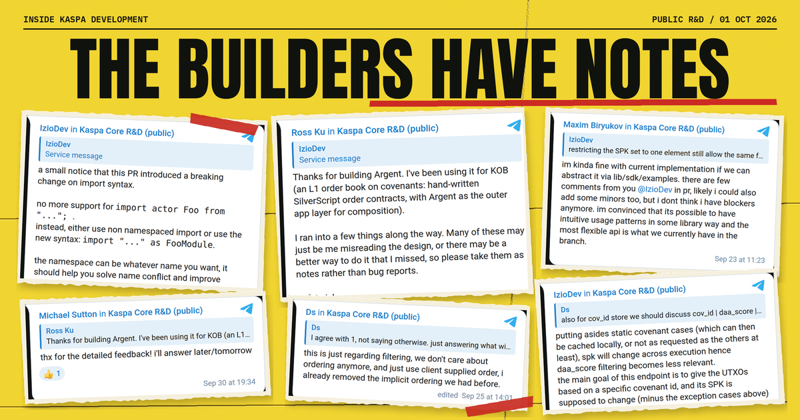
The building blocks have been arriving ever since. KIP-21, written by Michael Sutton, Biriukov and Hans Moog and dated February 2026, gives each app its own ordered stream of transactions, called a lane, so the cost of proving an app grows with that app's own activity rather than with all of Kaspa (KIP-21). Toccata switched lanes on in June, together with the proof-checking instruction and covenants, scripts that control where locked coins can go next.
On 24 September, three days before the essay, Biriukov's tic-tac-toe game went live on Kaspa testnet as the first app built this way. He announced it as "the first vprog, a verifiable program with real execution and real settlement" (announcement). Each match is played off the chain, and the winnings move only after Kaspa has checked a proof that the match was played by the rules (kaspa.news on the game).
The hard part, and the layer in between
Buterin expects the hardest part of his plan to be "managing and parallelizing access to very large amounts of state", the balances and app data a network has to remember. He wants apps to break their work into "well-encapsulated dependencies that can be parallelized", with fees that reward that structure, and he imagines "a stronger decentralized layer in the middle between users and a chain, that is not itself a chain".
The vprogs yellow paper starts from the same place. Every transaction "explicitly declares" the accounts it will read and the accounts it will write, so Kaspa can work out in advance how transactions depend on each other. The extra work one app's data creates for another is metered as "scope gas", and the paper presents its model as "a direct path to state-size scalability" that "also enables the horizontal scaling of computation" (vprogs yellow paper).
Sutton has described the node that would run these apps in terms that sound a lot like that middle layer. "Call it L2, L1.5, or an L1-node plugin," he wrote, software that follows the apps a user chooses and checks their state against Kaspa (Sutton).
Not all of it is built yet. Sutton estimates that about 30% of the yellow paper already lives in Kaspa through KIP-21, the piece that "makes small/mid apps economically viable" (Sutton). He calls Biriukov's game "a standalone vprog", with the full design, where separate apps act together in a single step, still to come on Kaspa itself (Sutton).
Buterin closes by saying that after Hegota, this transformation "becomes Ethereum's primary story". On Kaspa, laid out by date, it reads like a story already under way. GHOST in 2013 and PHANTOM in 2018, ten blocks a second in May 2025, the vprogs yellow paper that September, real-time decentralization in February, proof checking switched on for mainnet in June and a proven game on testnet three days before the essay appeared.