The largest address on Kaspa holds 1.57 billion KAS, about one coin in every 18 in circulation. On X, new arrivals are often reported as a whale that keeps accumulating. The full record says more. Almost every coin came out of wallets that explorers tag with the names of six exchanges, and about 72 million KAS has gone back towards five of them.
Of its 584 transactions, 554 brought coins in and only 30 sent coins out. All 30 of those left on a weekday, 27 of them between one and three in the afternoon, Central European time. Nobody has shown who owns it. Gate, the exchange named on the tag most coins came from, says it isn't the owner.
Explorers tag it as Entity X. It holds more than the next two addresses on the top list together. Only the 11 addresses tagged as Kraken together hold more, 1.66 billion KAS.
Several accounts on X have followed this wallet for a long time. Kaspa Report has measured it against newly mined coins since January 2025. Kaspa Daily listed where its coins came from in August and has reported most of its payments since, usually within a day. KasLens traced one of its payment routes back to a community fund from 2023.
For this report, kaspa.news read every transaction of the wallet, from the first in March 2024 to the latest on 26 November. It also followed the unnamed addresses on both sides of the wallet to the tagged wallets behind them.
Nine coins in ten came straight from an exchange-tagged wallet
The name tags come from one list. A public Kaspa data service keeps 138 named addresses, and the explorer takes its tags from there. Nothing on the chain proves a tag. So an exchange name in these counts always means the wallets the explorer tags with that name.
The wallet has received 1.65 billion KAS in 554 arrivals. Nine coins in ten came straight from a tagged wallet. The other 148 million KAS passed through unnamed addresses first. In its August list, Kaspa Daily put that share down as unattributed.
Followed back, those trails reach the same tags. Of those coins, 132.5 million came out of the Gate.io-tagged wallet, 12.7 million out of KuCoin-tagged wallets and 2.7 million from addresses that otherwise pay into a Bybit-tagged wallet. With every trail followed to its start, the arrivals split like this.
- 1.13 billion KAS came from the wallet tagged as Gate.io. That's 68 coins in every 100.
- 304.6 million KAS came from wallets tagged as Bybit, counting those 2.7 million.
- 143.1 million KAS came from the wallet tagged as Bitget.
- 34.5 million KAS came from wallets tagged as Bitvavo.
- 23.5 million KAS came from wallets tagged as Kraken.
- 14.7 million KAS came from wallets tagged as KuCoin.
That leaves roughly 1,200 KAS in small payments from unnamed addresses, less than one coin in a million.
The trail starts in October 2023 with a 70 KAS withdrawal from the Gate.io-tagged wallet to an unnamed address. Millions followed, to that address and to a second one. On a Monday morning in March 2024, 141.6 million KAS from those early withdrawals reached the wallet within eight minutes. One transfer carried 90 million KAS, still the largest single arrival.
Kaspa Report walked the same early trail in a thread in March 2025, when the wallet ranked second. That thread also argues for a probable owner, which nobody has confirmed.
Gate says the wallet isn't its own
Most of the wallet's coins came out of the Gate.io-tagged wallet, so holders have asked whether the largest wallet is that exchange's own. In November 2025 an X user asked Gate exactly that. Its support account replied that the wallet "is not owned or managed by Gate".
The letters N4uk5a in the reply are the end of this address. The reply is the exchange's word, and the chain can't check it. On the chain, a customer's withdrawal and an exchange moving its own coins look the same. If the reply is right, the coins left the exchange as someone's withdrawals. Gate didn't say whose. The exchange has gone by Gate since 2025 (press release), and the explorer's tag still carries the older name.
A withdrawal doesn't show who bought the coins, when, or at what price. The biggest mistake, baal.k wrote in November, is calling every withdrawal a purchase. At each day's closing market price the arrivals were worth about $139 million. Today the balance is worth about $42 million, with KAS near $0.027. Neither number is what the owner paid.
Guesses on X have named exchanges and market makers. None has been confirmed, and none is repeated here. The same thread by baal.k lists what would settle the question. One is a message signed with the wallet's key, which only the owner can produce. Another is custody records that others can confirm.
One KAS for every two mined in 2025
Miners now earn about 1.68 million KAS a day, and the reward shrinks a little each month. In 2025 miners earned about 1.63 billion KAS. The wallet's balance grew by 834 million that year, 51 KAS for every 100 mined. In 2026 so far it's between 41 and 42 for every 100. Since that first 70 KAS in October 2023, miners have earned about 6.6 billion KAS, and the wallet holds close to a quarter as much.
October 2025 stands out. The balance rose by 236 million KAS while about 111 million were mined, as Kaspa Report pointed out at the time. It's still the only month in which the wallet grew by more than miners earned. Most of that month's growth came on one Tuesday, in two withdrawals from the Gate.io-tagged wallet 16 minutes apart. One carried 65 million KAS and the other 89 million. The balance has fallen in one month only, May 2026.
That compares sizes and nothing more. The coins came out of exchange-tagged wallets, and the chain doesn't say who held them before that.
Mondays, Thursdays and ten past two
The rhythm isn't a new find. Kaspa Report wrote in March 2025 that the wallet's deposits came on weekdays at the same time of day. It took that as a sign that a business, not one person, likely controls the wallet, and probably an exchange. Kaspa Daily wrote in August that the bunching on particular days points more to a scheduled programme than to buying by hand. The full record puts numbers on it.
The wallet has made 306 moves of 100,000 KAS or more, counting arrivals and payments. Monday and Thursday carry 194 of them. And 150 fall on a weekday between 13:00 and 15:00, Central European time.
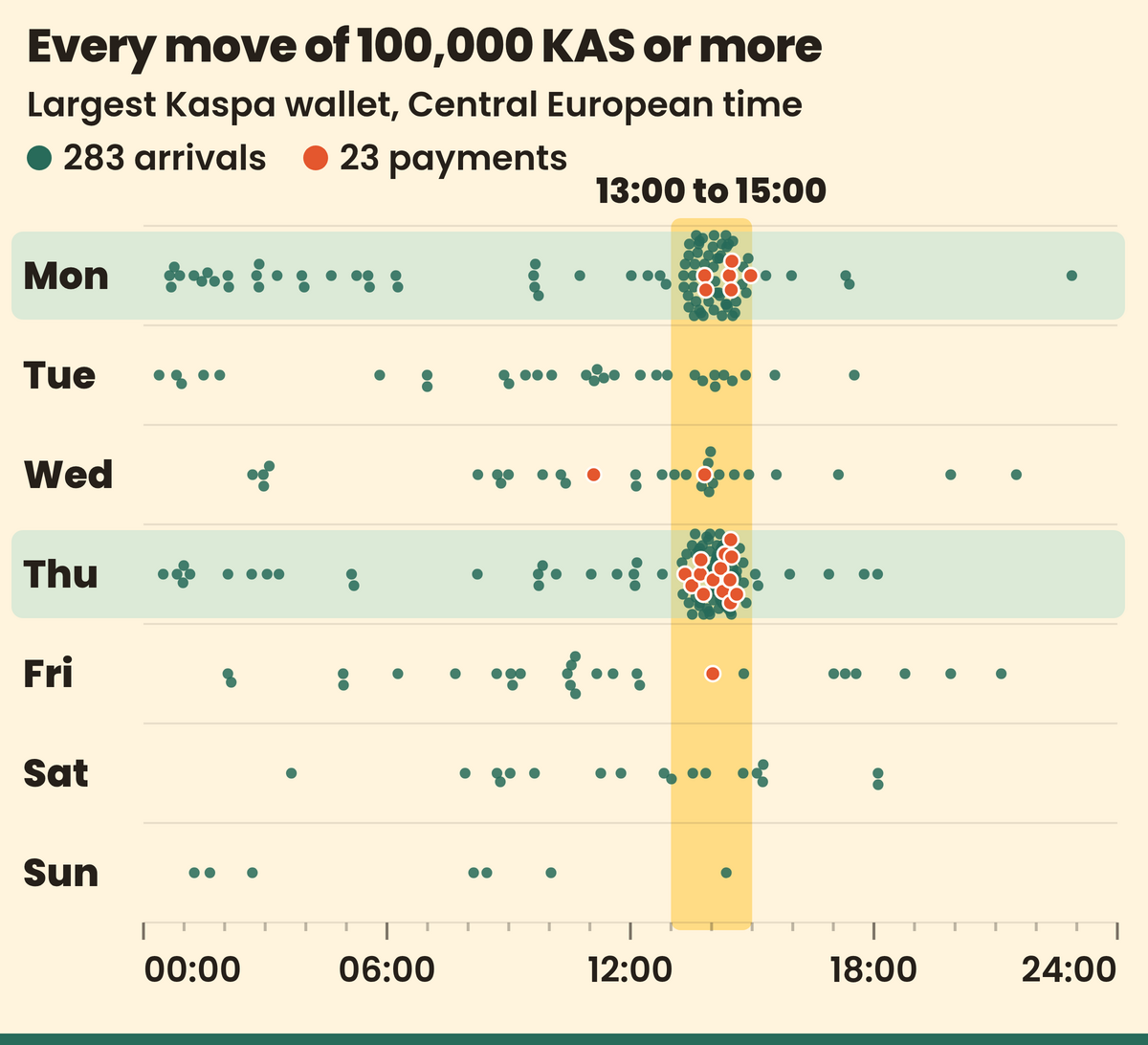
Arrivals depend partly on when an exchange pays out. Payments are the owner's own doing. All 30 left on a weekday, 16 of them on a Thursday. Of the 23 large ones, 20 left on a Monday or a Thursday, and 22 between 13:00 and 15:00.
The routine runs on European time. Those 22 payments left at 14:08 on average in winter and at 14:10 in summer. The routine follows the clock change, as office hours do.
Britain and Portugal change on the same days, so the chain can't tell ten past two in Central Europe from ten past one in Britain. North America changes on other days. The two are out of step for a few weeks a year. In those weeks the wallet made 16 large midday moves. Their average sat 14 minutes from the European routine and 47 minutes from a North American one. The sample is small, and it points to Europe. It says nothing about who sits at the desk.
The owner can be careful. One Thursday in September 2024 the wallet sent 300 KAS to a new address at 14:18, a test that Kaspa Report also noted. The next Thursday at 14:20 it sent 1,140,000 KAS to the same address. The one large payment outside the two afternoon hours left at 11:05 on 24 December 2025.
Arrivals keep longer hours. Of the 283 large ones, 83 came outside 08:00 to 18:00 on weekdays, all of them from exchange-tagged wallets.
The pattern fits a company that handles coins for customers, such as a broker, a custodian or a fund. The chain can't confirm that. One careful person with a routine would leave the same trail.
About 72 million KAS went back the other way
The 30 payments add up to 77.3 million KAS. That's less than 5 coins for every 100 received, and 59.7 million of it left in 2026.
None of the 30 went to a tagged wallet. Instead 71.7 million KAS went to unnamed addresses that passed it on to an exchange-tagged wallet. That is how a deposit address behaves. Sorted by the tag at the end, the payments split like this.
- 34.5 million KAS went towards a wallet tagged as Bitvavo.
- 13.2 million KAS went towards the wallet tagged as Gate.io.
- 12.6 million KAS went towards a wallet tagged as Bybit.
- 8.3 million KAS went towards the wallet tagged as Bitget.
- 3.0 million KAS went towards a wallet tagged as Kraken.
Another 5.65 million KAS still sits in three unnamed addresses.
Parts of this were known. Kaspa Report read the Bybit route as a customer's deposit address in March 2025. KasLens flagged payments towards the Bitvavo tag early in 2026. Kaspa Daily has reported most payments since August, in several cases with the exchange tag they led to. And baal.k wrote in November that older tracking showed about 70 million KAS going out, some of it later linked to exchange addresses. The split above follows all 30 to the end.
A deposit doesn't prove a sale. Kaspa Daily made the same point when 4.78 million KAS left in November.
Two days before that payment, 8.47 million KAS had arrived from the Bitvavo tag. The first payment towards that tag left in October 2025, and the first arrival from it came in January 2026. In all, the wallet has sent 34.52 million KAS that way and received 34.55 million KAS from it, in turns. The two totals haven't always been this close, and the chain doesn't show what the traffic is for.
With the Bitget tag the latest moves went both ways too. On a Thursday in November at 14:16, 2,606,137 KAS left for the address that feeds the Bitget-tagged wallet. Six days later, in the night of 25 November, 2,375,806 KAS arrived from that same wallet, and 1,028,280 KAS more the next afternoon.
With the Gate.io tag the traffic is lopsided. The wallet took in 1.13 billion KAS from it and sent 13.2 million back. Those coins went through a deposit address, as a customer's would. That fits what Gate said.
One deposit address, two senders, two years apart
That 13.2 million KAS went to a single deposit address, and the address has a past. KasLens traced that past and walked through it in a video.
In June 2023 Kaspa Project posted on LinkedIn about a funding pool "to secure a $KAS listing" on Bitpanda (LinkedIn). The goal was $5,000, and the listing came on 13 July 2023 (community timeline). As KasLens tells it, the money was meant for a giveaway of KAS to Bitpanda users. In four days, 95 payments brought about 244,800 KAS to the pool's address.
A week later the pool's holder sent 1 KAS to an unnamed address as a test. Two hours later 235,000 KAS followed, about $6,000 at that day's prices. Two days after that the coins moved on into the Gate.io-tagged wallet, the way deposits do. KAS did reach Bitpanda that summer, through Spotlight, its section for new and hard-to-find crypto projects (Crowdfund Insider). The chain doesn't show who held the pool's keys.
Then the address got nothing for two years and a month. In July 2025 it received 4,794,864 KAS from the largest wallet. Four more payments followed, the latest in October 2026. Only two senders have ever paid that address, the pool's holder and the owner of the largest wallet. None of the wallet's known addresses is among the 95 donors, and in June 2023 the trail of its coins hadn't started yet.
What this proves is narrow. If the address belongs to one customer account, as deposit addresses usually do, that account took in the pool's coins in 2023 and the wallet's coins from 2025. It doesn't prove who holds that account. And nothing on the chain shows that Bitpanda received these coins, holds that account or has any link to the largest wallet.
KasLens offers two readings that fit every payment. The pool's holder and the wallet's owner are the same. Or the account belongs to a go-between who handles coins for other people, and the wallet's owner is one of them. The video also says that sending campaign coins to an exchange isn't wrong in itself, and that nothing in the trail says the giveaway didn't happen.
KasLens names nobody, because it has no name and won't guess one. The exchange behind the Gate.io tag knows whose account it is, the video says, and perhaps the people who organised the pool do too.