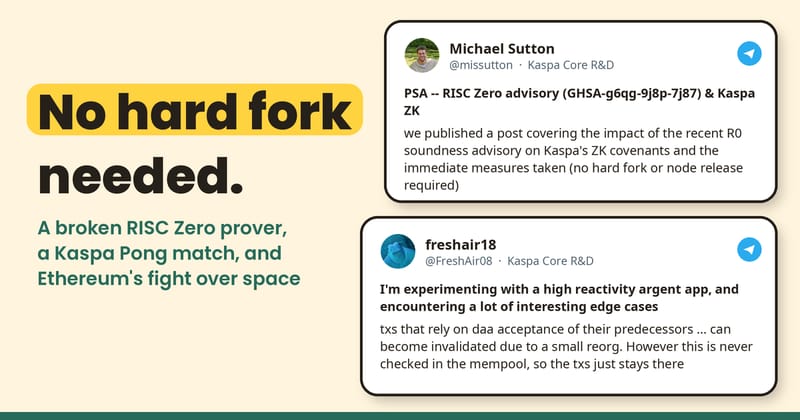
A flaw in RISC Zero, an external zero-knowledge proving tool, just gave the Kaspa proof system its first real emergency test. One verification mode brushed it off with a library update and no hard fork, while the other was deprecated for new apps because its faulty rules sit inside consensus.
In the same stretch, an on-chain Pong game slimmed down bloated covenant transactions and exposed four practical rough edges in the mempool, the waiting room where transactions sit before miners pack them into a block. Over on Ethereum, developers are fighting the same physical squeeze from two more angles, proposing steeper fees for storing new data and a way to fold giant future proofs together before they ever touch a block.
A real bug tests two ways of checking proofs
Zero-knowledge proofs only protect money when a proof cannot be faked. RISC Zero disclosed a critical soundness flaw in its Groth16 wrapper and recursion circuit that broke that rule. Someone holding a single valid proof could swap in a chosen false claim and still pass verification. RISC Zero yanked the affected packages, including risc0-circuit-recursion 4.0.4, and shipped patched circuits with a new verifying key in RISC Zero v3.1.0 (risc0-groth16 3.0.6).
That left builders using Rusty Kaspa v2.1.0 pinned to the older risc0-zkvm 3.0.4, a mismatch developer akdadoc flagged in issue #1173.
The response landed in developer libraries rather than node software, so miners and node runners did not have to upgrade anything. Michael Sutton wrote pull request #1176, which Ori Newman merged. The fixed kaspa-txscript 2.2.0 and kaspa-txscript-zk-sdk 2.2.0 went out with all 168 script and ZK SDK tests passing, and the earlier 2.1.0 versions were yanked on crates.io so builders cannot pull the broken keys by mistake. Hours later, Newman merged SilverScript #265 and released SilverScript v1.0.2, moving r0.g16.verify to SDK 2.2.0 and blocking r0.succinct.verify with an advisory error. SilverScript remains experimental and has no published external audit (security policy), and the Argent contract compiler will follow with its own update.
The reason only half of the Kaspa zero-knowledge toolkit needed emergency surgery comes down to how KIP-16, the proposal that added the OpZkPrecompile proof-checking instruction, splits its work into two modes (Sutton write-up, Kaspa R&D chat).
Mode 0x20 is a generic BN254 Groth16 verifier that knows nothing about RISC Zero. The spending script itself supplies the proof, the verifying key, and the public inputs. Any app built on Circom, Noir, SP1, or custom circuits never felt a ripple, and new RISC Zero Groth16 covenants simply switch to SDK 2.2.0 and RISC Zero 3.1.0 so the patched key rides along in the script.
Mode 0x21, the native RISC Zero STARK verifier, made a tighter trade-off. An uncompressed STARK recursion circuit takes roughly 70 KB, far too heavy to include inside every spending transaction. To save space, Kaspa baked the 4.0.4 recursion circuit and its control root straight into consensus rules. Once that circuit turned out to be flawed, consensus could not swap it out without a hard fork. 0x21 is now unsound and deprecated for new apps. Because RISC Zero removed the old crate, Sutton archived the exact verifier source files into kaspa-r0-recursion-legacy 0.1.0 so nodes keep compiling and legacy coins stay spendable, while stripping the native STARK builders out of the SDK.
Timing spared real users. Sutton notes there are no publicly known production ZK apps live on mainnet yet, with current mainnet usage sitting in native covenants while ZK apps remain on testnet and in development. Still, the episode raises a tougher question for anyone locking real money in immutable code. Pinning one Groth16 verifying key forever removes governance risk, yet leaves no clean switch if an upstream prover breaks later. Sutton floats an opt-in application-level "verifier router" covenant, spent alongside app transactions under multisigs, timelocks, or user exit windows, or stacking two independent proof systems together. For native STARKs, a future hard fork could drop the hardcoded circuit in favour of compact on-chain circuit updates compressed against a shared base dictionary. "Zero-knowledge proving systems are still young, fast-moving cryptography," Sutton writes.
What an on-chain Pong game uncovered in the mempool
A very different weight problem showed up on a 58-by-32 digital court. Developer freshair18 is building an experimental two-player multiball Pong game directly on Kaspa covenants using Argent, with up to six balls moving at once and no game server or referee in the middle.
Running fast back-and-forth moves exposed quiet bloat inside the Argent runtime. Whenever a contract entry could branch into more than one possible next state, the runtime packed the static template bytes for every branch into the signature script, even for paths the move never took. Every ordinary paddle contact in Pong had to drag around the heavy winner-payout script used only when a match ends. After freshair18 opened Argent #75, Sutton automated the fix inside the compiler and ordinary build() flow so unused static templates drop out automatically (R&D chat, follow-up). In the game itself, freshair18 had already cleared out local compiler hacks in kaspa-pong #7 and wired game queues to fund their own collection and cleanup transactions.
Slender scripts solved only half the friction. Real-time play also pushed straight into four limits in the Kaspa mempool, laid out by freshair18 in the Kaspa R&D chat. None is a consensus flaw and no funds were lost, yet each one slows down active covenant apps.
When a small reorg invalidates a pending transaction that relies on a specific DAA score, nodes do not automatically flush it. That dead transaction can sit in the mempool for up to 24 hours, forcing the app to use replace-by-fee to clear its own lane even when blocks have plenty of room (R&D message).
Trying to replace a rival transaction hits a second snag. In a shared covenant app, such as claiming a timeout right as an opponent sends a move, the builder does not already know the competing transaction's fee or mass. Right now the node replies with a plain-text rejection string carrying only the conflicting transaction ID (R&D message, issue #1174). At least three other Kaspa apps already parse human-readable error strings to get around missing fields, which means even fixing a wording typo in node code could break live software.
Two more replace-by-fee limits sit right behind that. The Kaspa mempool code already knows how to replace several conflicting transactions in one go, yet the public RPC method submitTransactionReplacement refuses any replacement that collides with more than one pending transaction, even when its fee rate beats every single one (issue #1175). And when a second transaction depends on a first one in the mempool, with each paying 0.5 KAS, replacing the first currently appears to require outbidding only its 0.5 KAS fee rather than the full 1 KAS of the pair (R&D message). All four items remain open discussions rather than merged fixes.
Ethereum hits the same storage and proof wall
Kaspa is not alone in finding out how fast heavy data and cryptography can crowd a base layer. Two active Ethereum proposals show the world's largest smart-contract network fighting the same battle from another angle.
The first is EIP-8037, a Last Call proposal authored by Maria Silva, Carlos Perez, Ansgar Dietrichs, and several other Ethereum researchers, and defended publicly by Vitalik Buterin ahead of the planned Glamsterdam upgrade. In January 2026 a Geth node's state database already stood around 390 GiB. After Ethereum doubled its block gas limit from 30M to 60M, daily new state did not simply double. It more than tripled from about 105 MiB to 326 MiB, putting nodes on pace for roughly 116 GiB of fresh permanent state every year. EIP-8037 responds by introducing a separate state-gas dimension alongside execution gas, raising the cost of creating accounts, storage slots, and contract code so annual growth stays near 120 GiB even if the gas limit climbs to 150M.
The second is EIP-8288, an early draft by Buterin and Thomas Coratger that tackles post-quantum signatures and zero-knowledge proofs head on. Today's elliptic-curve signatures are tiny, whereas hash-based quantum-resistant signatures run roughly 2 to 3 kB and cost 150,000 to 200,000 gas each to check. Client-side STARK proofs are heavier still, taking 128 kB to 512 kB and millions of gas. Dumping those directly into blocks would choke throughput. EIP-8288 proposes shifting the heavy lifting into the mempool, letting transactions list signatures and STARKs as lightweight dependencies that mempool nodes and block builders fold recursively into one block-wide STARK, targeting 3,000 gas per signature and 30,000 gas per STARK.
Even in that early draft, the same core tension surfaced almost immediately. In the Ethereum Magicians discussion, Ethereum developer Zsolt Felfoldi argued against baking one specific signature scheme, leanSPHINCS, into the protocol as a first-class feature, pushing instead for a more generic dependency verifier.
Two answers to state bloat and quantum math
On disk bloat, Kaspa and Ethereum split cleanly. Ethereum keeps global account state alive indefinitely on full nodes, so scaling execution means charging steep rent for new bytes through two-dimensional gas. Kaspa prices UTXO storage footprint directly through KIP-9, the storage mass rule that makes floods of tiny outputs expensive, while ordinary nodes prune old history and hold only current unspent coins, leaving full history to separate archival nodes.
On quantum readiness and proofs, neither chain is finished. EIP-8288 is still a draft, and Kaspa does not verify post-quantum signatures yet. KIP-22, now being moved to the Kaspa Calls for Convention list as a proposal for hidden-key addresses, shields a wallet's public key until coins are spent, cutting exposure without replacing the underlying signature math.
Both the RISC Zero flaw on Kaspa and the debate under Ethereum's EIP-8288 point to the same engineering limit. When fast-changing proof code sits inside consensus rules, fixing it takes a network upgrade. Sutton summed up the direction directly after shipping the patch, writing that the plan is to "keep Kaspa L1 focused on generic cryptographic primitives, avoid hardcoding external circuits in consensus wherever possible, and leave upgrade policy at the application layer."