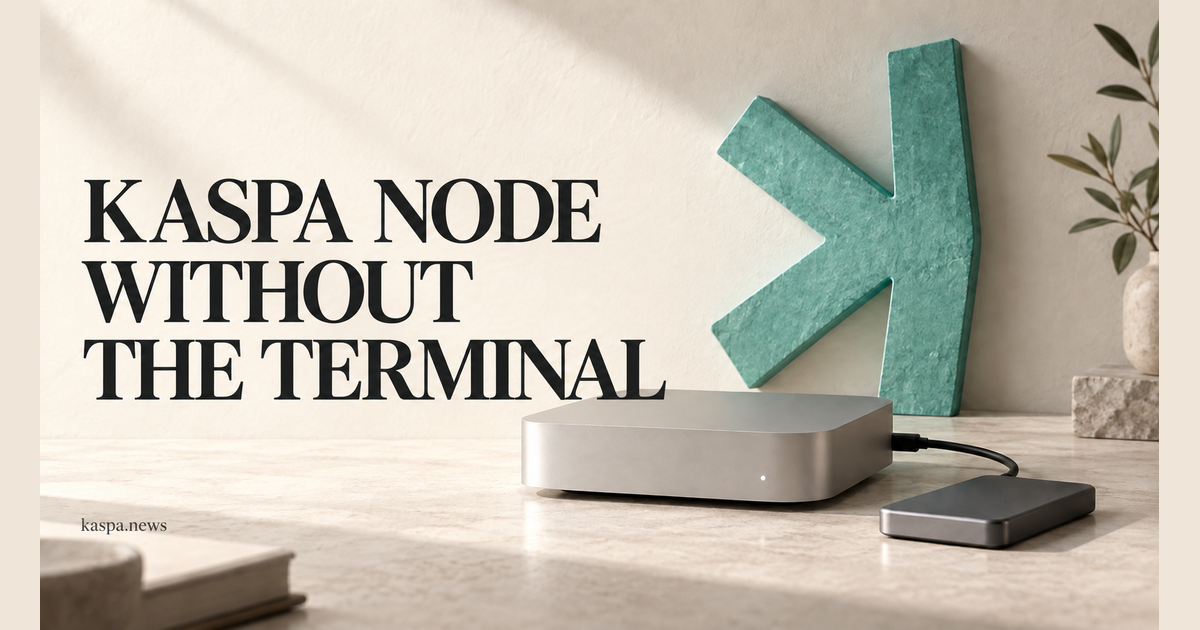
₿RT 𐤊 🐈📈 (@brt2412) released Kaspa Node for macOS, a native graphical control panel around the existing Rusty Kaspa node. Kaspa nodes already ran on Macs. This release puts setup, storage selection, status, start and stop, and recovery in a window instead of a terminal. The current public release is v0.1.0 (v0.1.0). It supports Apple Silicon and Intel Macs running macOS 14 or newer. It is not a wallet and it never asks for a seed phrase or a private key (project description).
kaspa.news has not independently tested the software.
Choosing a disk and starting the node
The app can inspect the computer before the node starts. The project associates Rusty Kaspa v2.0.1 with 8 CPU cores, 16 GB of RAM, about 640 GB of free SSD space, and about 80 Mbit/s of bandwidth (first-time setup). Those figures are this project's recommendations, not absolute requirements.
The setup wizard defaults to Mainnet, with Testnet 10 as the other listed network (network settings). The owner chooses where blockchain data lives, including a fast external SSD if it stays connected and mounted whenever the node runs. The app then creates a Kaspa folder in that location.
One default setting keeps the node usable by local wallets and mining services. Incoming peer connections through the router are a separate choice, as is letting other machines on a trusted private network talk to the node. If macOS asks for incoming network permission, the project tells owners to approve it only after they turned on that local network option.
The first synchronization can take hours and use substantial bandwidth. Keep the Mac powered and the chosen disk attached. Ordinary downtime does not mean starting over. Reconnect the disk, open the app, and start the node if it is stopped.
Status, start, and stop
While the app is open, Overview shows the Rusty Kaspa synchronization stage, storage use, uptime, connected peers, and recent activity. Until the node reports that it is fully synchronized, the app reads progress from the node logs. Some early phases have no complete percentage (sync display).
Clicking the red window-close button leaves the app and the node running. Quit from the Kaspa Node menu, or Command-Q, stops both cleanly. Pressing Stop leaves the node off until the owner starts it again. If the node process exits on its own, the app tries to restart it with increasing delays, capped at 60 seconds (recovery).
The app prevents idle system sleep while it is open, and it still needs a logged-in, awake Mac. Manually sleeping the machine, closing a MacBook lid, or losing power takes the node offline. It resumes the existing database after the Mac wakes. Open at Login starts the app after the user signs into macOS. It does not run before that login.
The app is distributed without Apple notarization, so macOS may warn that Apple cannot verify the developer. The project asks that downloads come from its GitHub Releases page. The panel is not mining software. ASIC miners generally do not connect to it as a mining server. Solo mining still needs a separate program such as the beta Stratum Bridge from Rusty Kaspa, which this application does not bundle (mining).