A person can install a Kaspa browser wallet and still never see it on a site they already use. The page has no shared way to notice that wallet, so the visitor is left with whatever list the developer wired by hand. The wallet they already trust never appears. They either switch to one the site already knows, or they leave.
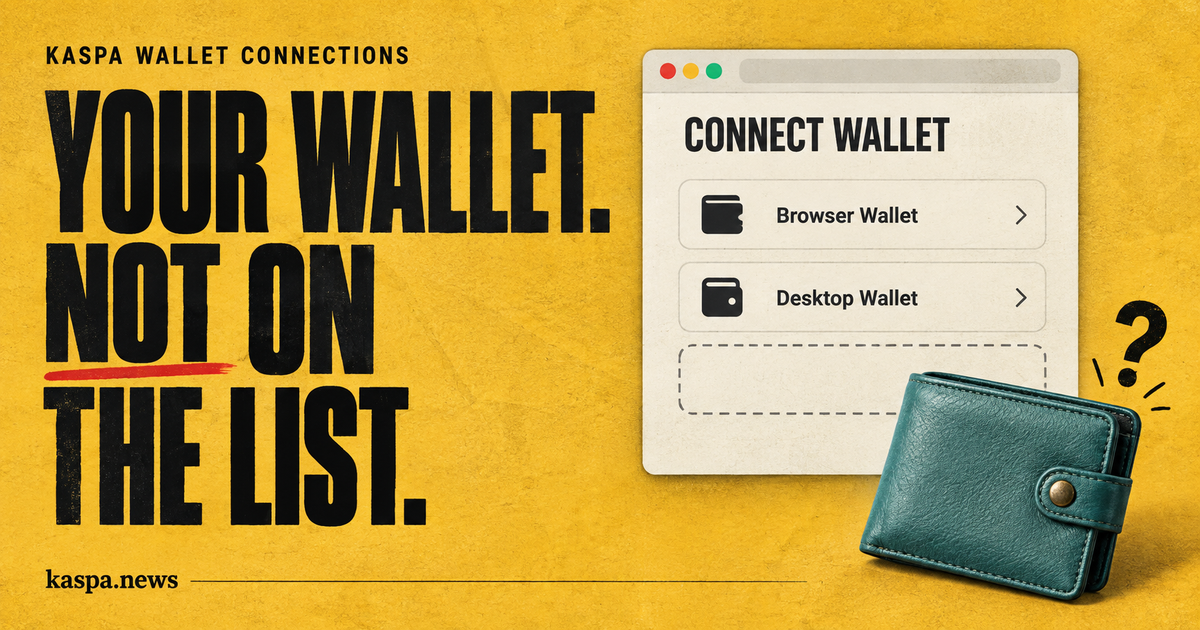
A browser wallet is a small program in the browser, usually an extension, that holds keys and lets a person approve a payment on a website without putting those keys on the page. Several Kaspa wallets already do that job. Each one still talks to websites in its own way, with its own names for requests and its own spelling of the network. A site that wants three wallets maintains three separate connections. A new wallet has to persuade every application to add one more (motivation).
Alexander Säfström is the lead author of a draft, dated 11 September 2026, that would give websites and wallets one common way to find each other and make requests. Romain Billot and four other contributors are listed with him. A website could ask which wallets are present. A wallet that follows the draft could answer. Both sides could then use one request path for accounts, permissions, and signatures. That only works for participating wallets and sites. The document is marked Draft. It remains open and unmerged (proposal) (pull request).
Ethereum ran into the same clash when wallets fought over a single slot and the last wallet to claim it won. Later conventions let a page ask which wallets are present and let each wallet answer. These authors followed that approach, then wrote the Kaspa details Ethereum does not have, including address prefixes and the form of a signed message.
Permission belongs to each website
Addresses stay hidden until the person grants that website permission. Exposing them to every page would let sites follow a person around the web, so a silent account query does not prompt. If the website was already allowed and the wallet is unlocked, it returns the authorised accounts. If permission was never granted, or the wallet is locked, it returns nothing. Permissions belong to each website. A nested frame that borrowed the surrounding page does not inherit them (accounts).
A wallet that never follows the convention stays invisible to a page that only listens for it. A site that never follows it still wires wallets one by one. A site still has to handle a wallet that cannot send a given payment, and it still has to understand the contracts it wants to offer.
A token payment still needs the person's coins signed
A Kaspa payment can mix coins the person must sign with other parts a website has already prepared, such as a token covenant. Ethereum's wallet interface has no equivalent requirement. The draft adds a signing mode in which the site builds the transaction and names the coins the wallet should sign (signing).
The website prepares the payment, including any token contract parts that already carry their own authorisation. The wallet signs the person's coins, leaves those prepared parts unchanged, and shows the whole payment for approval, including destinations, amounts, and the fee. When the payment is submitted, every part is still checked against the rules that govern it. Token ownership can itself require signatures.
A fake wallet listing can still lead to real losses
Any script on the page can copy another wallet's name and look. A spoofed listing holds no keys and cannot forge a signature. It can still set up a phishing flow that ends with a real approval in the real wallet, and that can move funds. The visitor thinks they picked their usual wallet, follows a prompt that looks familiar, and then confirms a payment in the wallet that actually holds the keys.
The document treats the page as hostile. Anything the site sees can be read, wrapped, or overwritten. Private data stays out of it. Consent and signing happen in an interface the wallet controls and the page cannot alter (security).
The proposal does not name a public implementation and needs a publicly available working implementation meeting its test cases before it can be marked final.